NOTES / 2025.10.29 · 44-post thread · 119 likes
Open Always, Eventually, Wins
Money is the last closed network. The next step is neutral, permissionless rails anyone can build on — because open compounds builders, accelerates progress, and crushes costs.
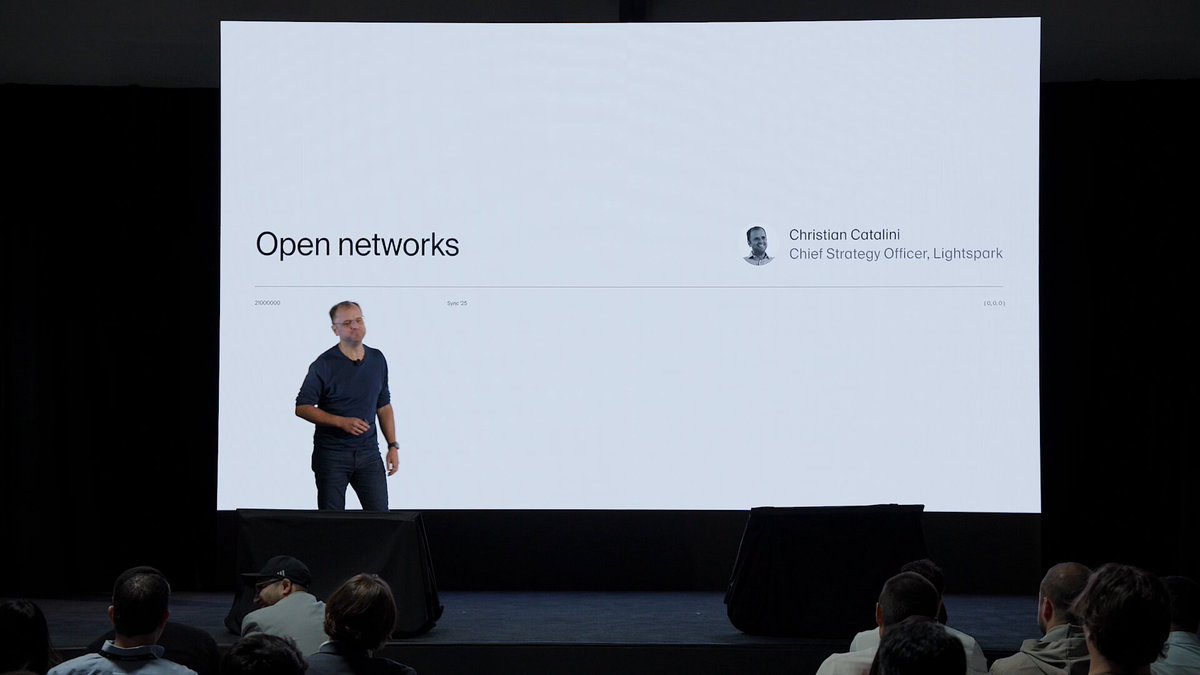
FIG. 01 — FROM THE ORIGINAL THREAD
“Open always, eventually wins.” Money is the last closed network. The next step is neutral, permissionless rails anyone can build on. Full talk ⬇️
The temptation today is to build shiny new CorpChains with higher walls. We’re here to build roads. Why? Because open compounds builders. Open accelerates progress. Open crushes costs.
The Silk Road wasn’t a road. It was a network. Nobody owned it, so it routed around emperors, taxes, and bandits—and moved ideas as easily as silk. That’s what open does.
Rome’s profound insight? You can’t run an empire on chaos. You need an operating system. So they built a standard. One road. One width. One currency. The cost of transport? It collapsed by a factor of ten. The empire clicked into place.
The proof? 2000 years later, the lights of Europe at night still trace the paths of those ancient Roman roads. Which leads to a key question: if the blueprint for progress has been so clear for so long… why have we failed to apply it to the most important network of all?
The enemy is fragmentation. This isn’t just “inefficiency.” 🚨 Fragmentation is the tax that the present levies on our future. It’s the friction that quietly grinds progress to a halt. And why does it happen? It happens when everyone builds their own little kingdom.
This is what fragmentation looks like in the real world. For a hundred years, this was global trade. It was called “break-bulk cargo.” And it was a nightmare. Every box, every barrel, every sack… loaded by hand. It was painfully slow. Wildly expensive.
The fix came from a total outsider: a trucker from North Carolina named Malcom McLean. He saw the problem wasn’t the ships or the cranes. It was the gap in-between, the interface. He had an idea so simple, it was revolutionary…
His idea? A simple, steel box. But the genius wasn’t the box itself. It was the standard. One design that worked on a truck, a train, a ship. One container. Every port. The cost to load a ton of cargo fell from $5.86 to 16 cents. A 97% reduction. The friction just… vanished.
This is England, 1840. Two rail lines, tracks different by a few inches. Total, predictable, maddening friction. This isn’t a history lesson. It’s a perfect picture of the future of money, if we get it wrong.
So why does this keep happening? The paradox: everyone wants an open standard, as long as it’s their standard. But the age of top-down standards… is over. The answer must be neutral. Permissionless. Finance already solved for fragmentation once over 50 years ago!
1960s. Every bank, its own card. Bank of America tried to build its own CorpChain. It failed. Spectacularly. The breakthrough? Cooperate on the platform, compete on the products.
It worked brilliantly. The growth of the network was staggering. But the story, of course, doesn’t end there. Because history has a pattern. The open network of one generation becomes the closed system of the next.
As a result, every company today faces the same choice banks had to make in 1976. This brings us to the only question that really matters: what’s in it for your company? Why embrace an open network?
It’s simple. More margin. Faster speed to market, and massive scale. Open networks pull demand toward you. They don’t erase winners. They change how you win. Maersk and IKEA didn’t own the container—they owned execution on top. Let’s unpack more of that playbook.
This was retail before 1974: every store was its own island. Checkout was slow. Inventory was guesswork. There was no universal language. And then came…
The Universal Product Code. One code. Every product. Retail become software. But at first, it almost failed. Retailers wouldn’t buy the expensive scanners from IBM until products had the codes. Manufacturers wouldn’t print the codes until stores had the scanners.
Then it hit a tipping point. Suddenly, the entire system clicked into place. A new rhythm for commerce was born. Scan. Ship. Scale. And those boring little lines? They ended up saving the grocery industry 17 billion dollars. Each year.
The savings were actually the least interesting part of the story. The real story is what happened to the companies that saw the future and adopted this standard first. They didn’t just get more efficient. They got faster. Smarter. More innovative.
Suddenly, they saw it all. What to build. Where to sell it. And what should be coming next. And when you have that kind of clarity, you don’t just think bigger. You go global. You build a supply chain on a scale the world had never seen.
The early computer industry? Same story. A world of proprietary systems. Every machine was its own universe. Software written for one wouldn’t work on any other.
Then, in 1981, IBM—the king of closed systems—made a fateful decision. To accelerate speed to market, they built their new PC with off-the-shelf parts from other companies… and licensed its beating heart from a little known software startup from New Mexico…
Microsoft. Bill Gates’ masterful move was to retain the rights to license MS-DOS to everyone else. IBM accidentally created one of the most influential open standards of our time: Wintel. A “natural experiment” in what happens when you pit closed against open.
And the results were not even close. While Apple controlled every piece of hardware and software… “Wintel” exploded. The open platform enabled a pace of innovation that others just couldn’t match. Within less than a decade, the PC had over 80% of the market.
It’s one of the most decisive victories in tech history. The lesson is brutal and absolute: markets don’t choose the best product. They choose the biggest, most vibrant ecosystem. Always.
The same happened in telecommunications. In the 90s, the mobile industry was a mesh of incompatible national systems. Costs were high and progress was slow. Then came a single, open standard in Europe: GSM.
The results were immediate and dramatic. Handset costs were cut in half. Suddenly, a phone wasn’t a luxury. It was for everyone. Millions of users rapidly turned into billions. The incumbents who fought it were wiped out. The companies that embraced it built the future.
Then came the internet. Like with Corpchains today, at the start, it was very tempting to bet on control: AOL, Apple eWorld, Microsoft Network. But on the other side was a simple, open protocol. It wasn’t a product. It was just a set of rules.
It wasn’t a fair fight. It was a complete annihilation. $2.1 trillion in value in the US alone. Why? Because you cannot curate the future. Permissionless innovation will always create exponentially more value than a closed system. Period.
So after all this history, you’d think the lesson would be obvious. What happens when you make the shift from closed to open? This chart shows you. It tracks a company’s market value, right at the moment they embrace public APIs. 39% more revenue growth!
Why? Because you stop being the bottleneck. You stop trying to do everything yourself. You invert the firm, and you unleash an entire ecosystem of developers and partners to build value with you.
The best part of open networks? Their most unexpected wins. The ones that break all the rules. 🐧 When Linux appeared, experts called it a ‘toy’.
It’s not as polished as Windows, it’s not an enterprise-grade server. It’s a hobbyist project. Today, we still hear the same thing about the Bitcoin network. It’s not as fast as our high-performance CorpChain. It is not Turing complete.
They are missing the point, just like Linux detractors did then. The power isn’t the features in version one. The power is the new, open architecture.
That ‘toy’ with a penguin mascot now runs 90% of the cloud, 100% of the top 500 supercomputers, and created $8.8 trillion in value. It became so dominant that its greatest enemy—the company that once called it a cancer—embraced it.
But here’s one last thing. This is a satellite. Part of a system called GPS. This wasn’t built for you and me…
It was built by the US military, for US the military. A closed box. A top secret tool… designed for one thing: strategic advantage and control. Then they flipped a switch. And they gave the signal away. To everyone. For free.
They handed humanity a superpower. Suddenly, a logistics company knows exactly where your package is. Suddenly, a couple of people can build a map of the entire planet, put it in your pocket, and you’re never lost again. 🗺️ It’s magic.
And here’s the beautiful thing. The truly beautiful thing. Nobody had to launch a satellite. Nobody had to ask permission. The foundation was just… there. Open. For all of us.
So we’ve seen this pattern. Again, and again, and again. And after two thousand years, we come to a choice: some people see the future of money — and they want to own it. Walls. Higher walls. Platforms. Closed platforms. A cage. Painted gold with partnership incentives.
They want to own the operating system of your money. And in their system… your organization doesn’t get root access.
So they come to you. With a great story about a CorpChain. Purpose-built for payments, they’ll say. You need our technology. You need our permission. You need our stablecoin. Remember: their rails, their rules.
Their vision has no room for architects. It only has room for tenants. We believe the architect should be you. This was never about technology alone. It’s about the freedom to build. The freedom to build the future without asking for permission.
Do we build higher walls? Or open roads that connect everyone? Open roads that belong to no one. Open roads that advance human ingenuity. ↘️ History only remembers one of those choices. It remembers the road builders.
Originally published as a thread on X.