WRITING / 2026.10.06 · ESSAY · SUBSTACK · 4 MIN
So Long and Thanks for All the Weights
Who will capture the gains from AI? Every general-purpose technology was born under weak appropriability: the inventors kept a sliver and the complements kept the rest. Why this time is not different, and how to survive the moatpocalypse.
Cite as Christian Catalini, “So Long and Thanks for All the Weights,” Substack, October 2026. catalini.substack.com ↗

FIG. 01 — WHO WILL CAPTURE THE GAINS FROM AI? EVERY GENERAL-PURPOSE TECHNOLOGY WAS BORN UNDER WEAK…
Is Anthropic the Pennsylvania Railroad? It bought 4.59B of revenue, ordered $518B more, and IPOs at peak utilization. In 1893 hundreds of railroads entered receivership. Society kept the tracks. Sears, the app layer, thrived.
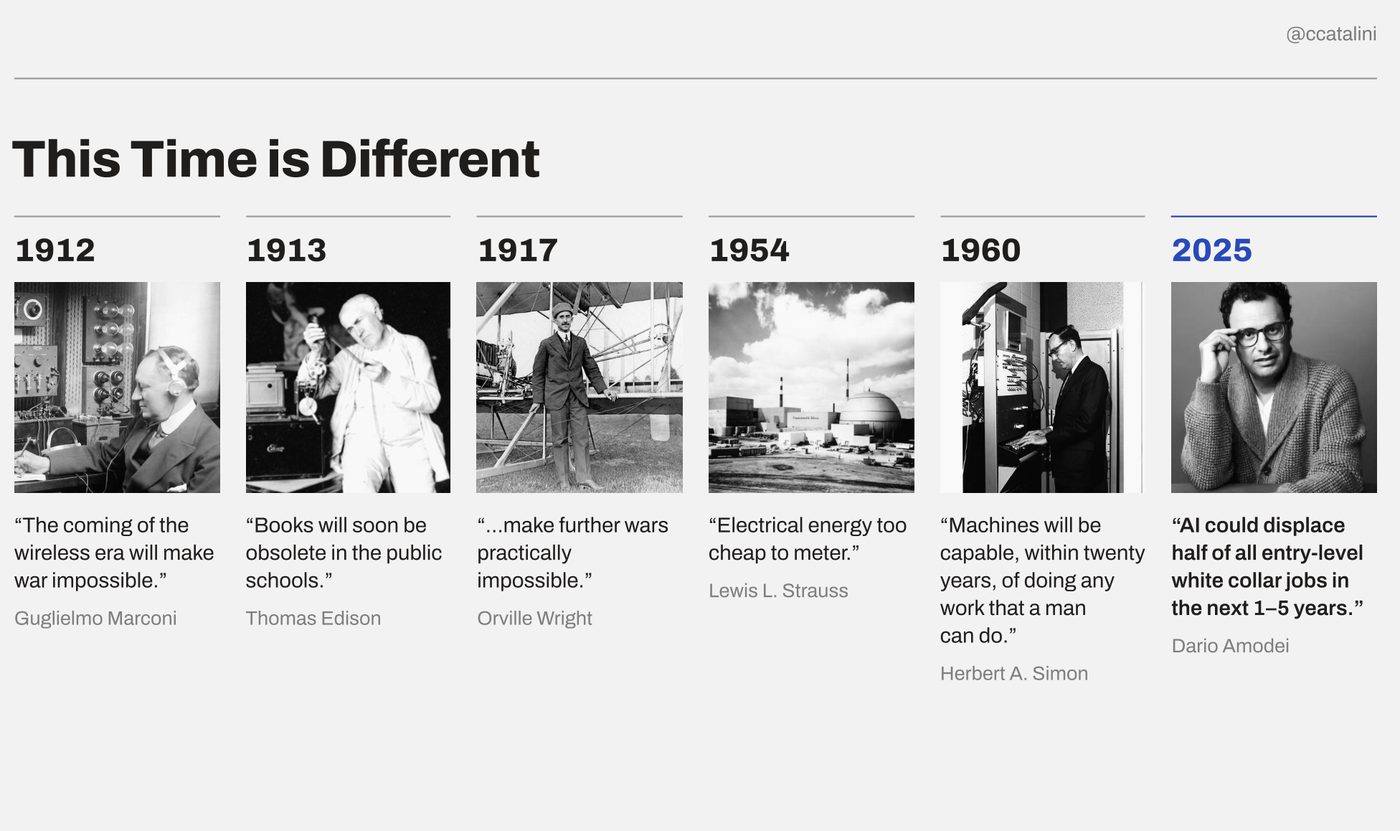
Inventors’ predictions about the impact of their own technologies have a terrible record. Radio was going to end war. Nuclear power too cheap to meter. Film, flight, computers: the confident calls, utopian or dystopian, aged worst. Each one was sure “this time was different”.
Will one of the AI labs be the last company standing?
No. Economic history is a graveyard of companies that built the future, then discovered they didn’t own it.
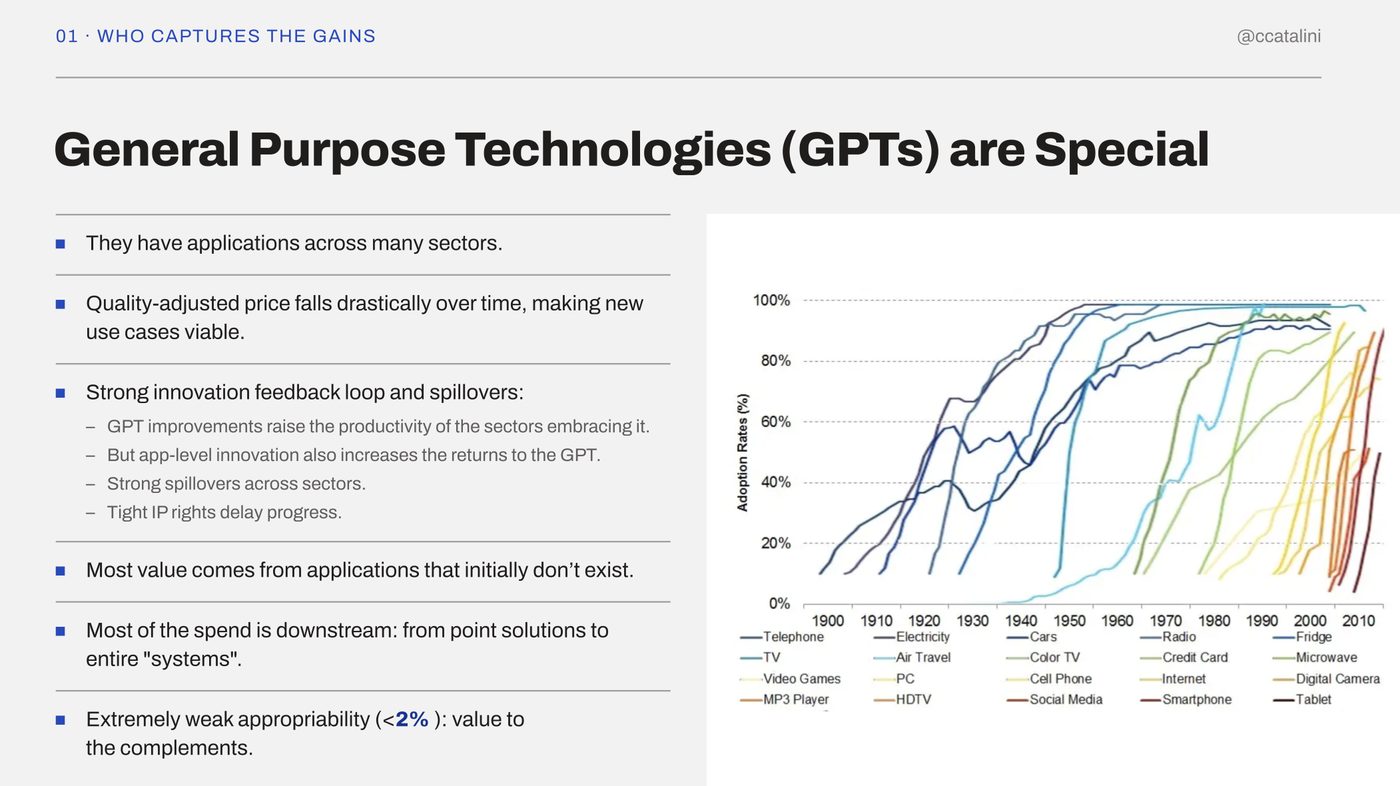
General purpose technologies (the original GPTs) are special. They span many sectors.
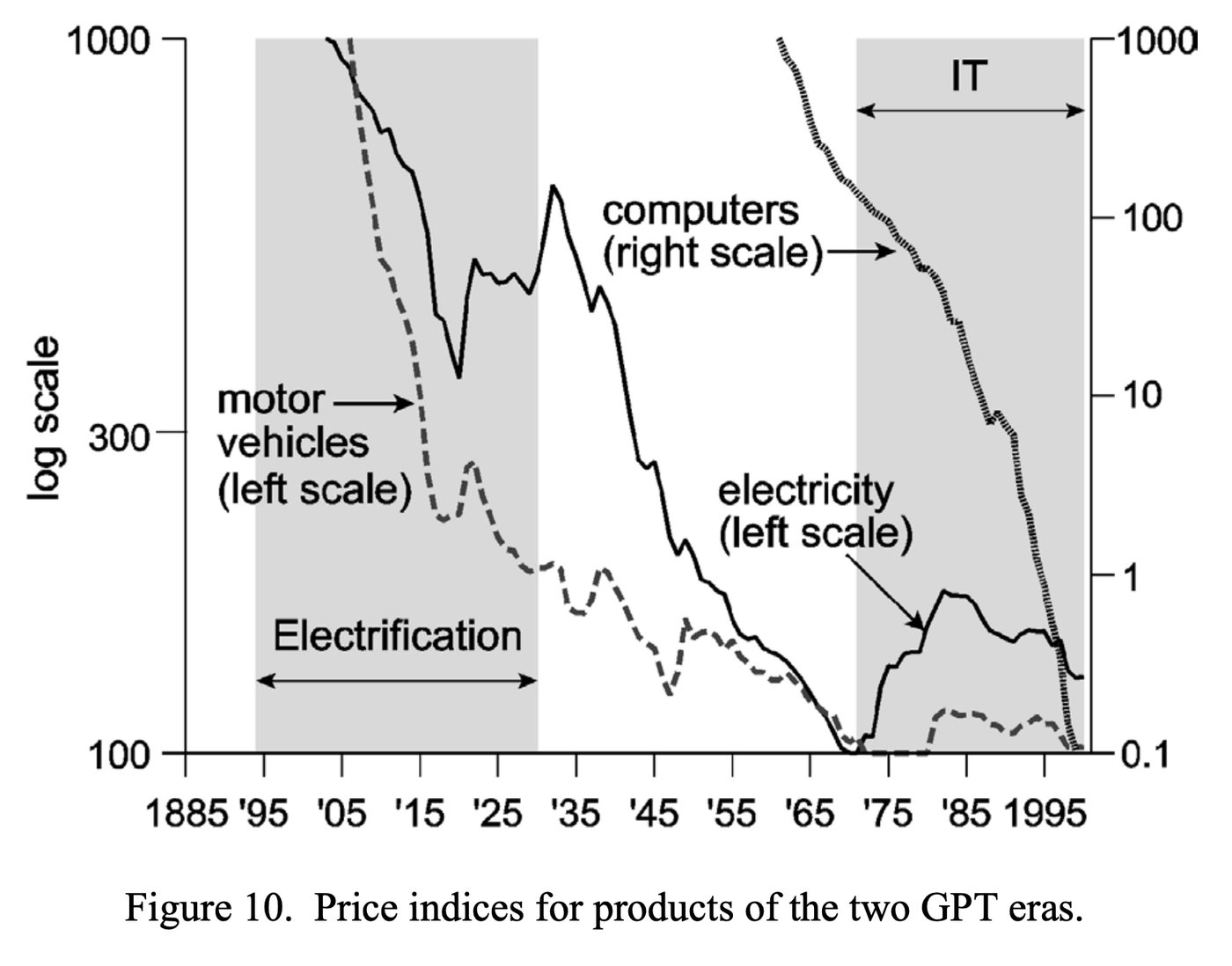
Their quality-adjusted price keeps falling, unlocking new uses. The layers feed each other: a better GPT raises app productivity, and better apps raise the returns to the GPT.
Getting the full benefit means redesigning entire systems, not bolting on point solutions.
GPTs also have weak appropriability. Nordhaus found innovators keep 2.2% of the surplus they create. GPT inventors likely keep less. The rest goes to the complements.
AI was born under a weak appropriability regime, like every GPT before it. There isn’t much the labs can do about it.
Two outs: domains where a patent enforces excludability, like bio, or where customers pay a lot for a small edge, like finance, cyber, and defense.
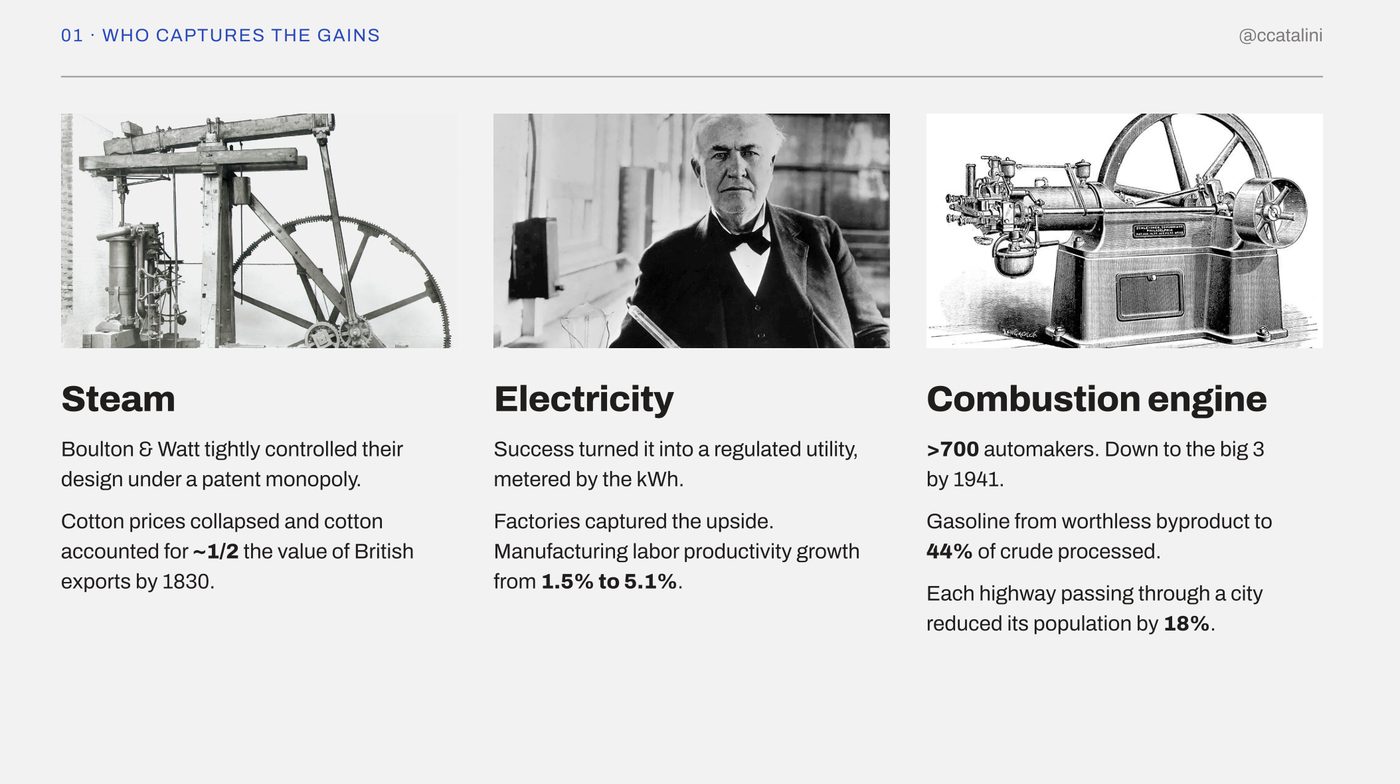
Steam? Boulton & Watt held the patent. Cotton boomed.
Electricity? A regulated utility. Factory labor productivity grew 5.1% a year.
Combustion engines? Gasoline and suburbia.
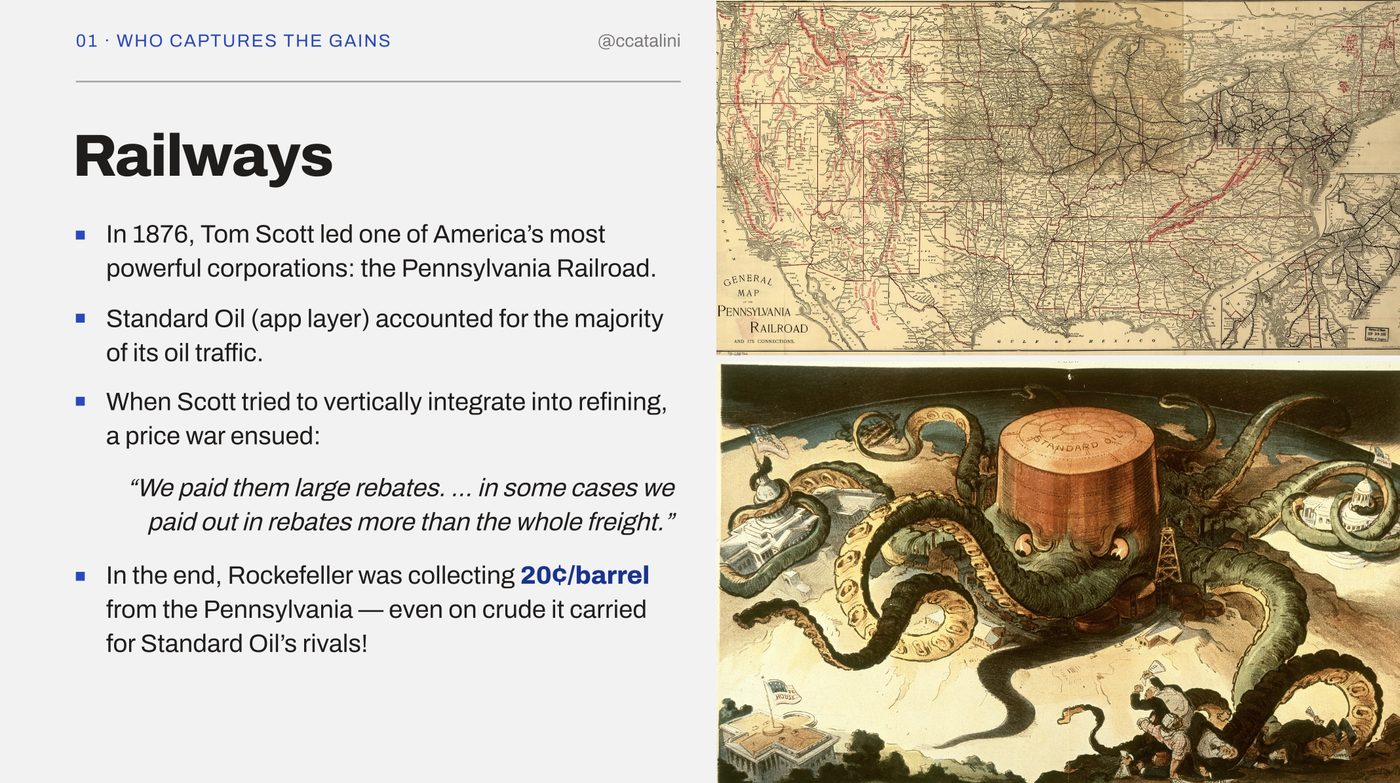
Railroads had their own Dario Amodei: Tom Scott, the “Pennsylvania Napoleon.” Standard Oil was most of his traffic.
Scott moved into refining to capture value (labs and pharma?). After the price war the Pennsylvania paid Rockefeller 20c a barrel, even on his rivals’ crude (!).
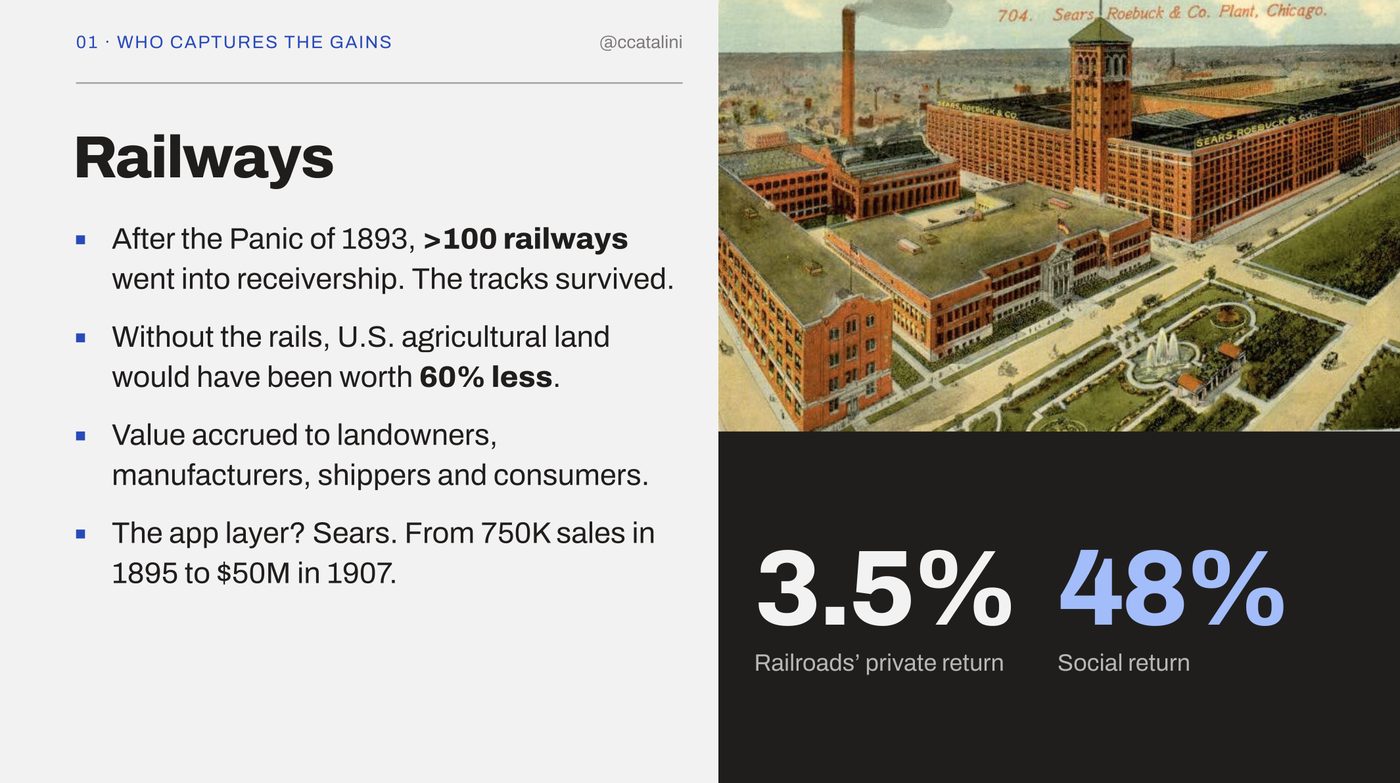
Over 100 railways went into receivership. The tracks kept running. Without them, U.S. farmland would have been worth 60% less.
Private return on the railroads: 3.5%. Social return: 48%.
Value accrued to landowners, manufacturers, consumers. The app layer (Sears) boomed.
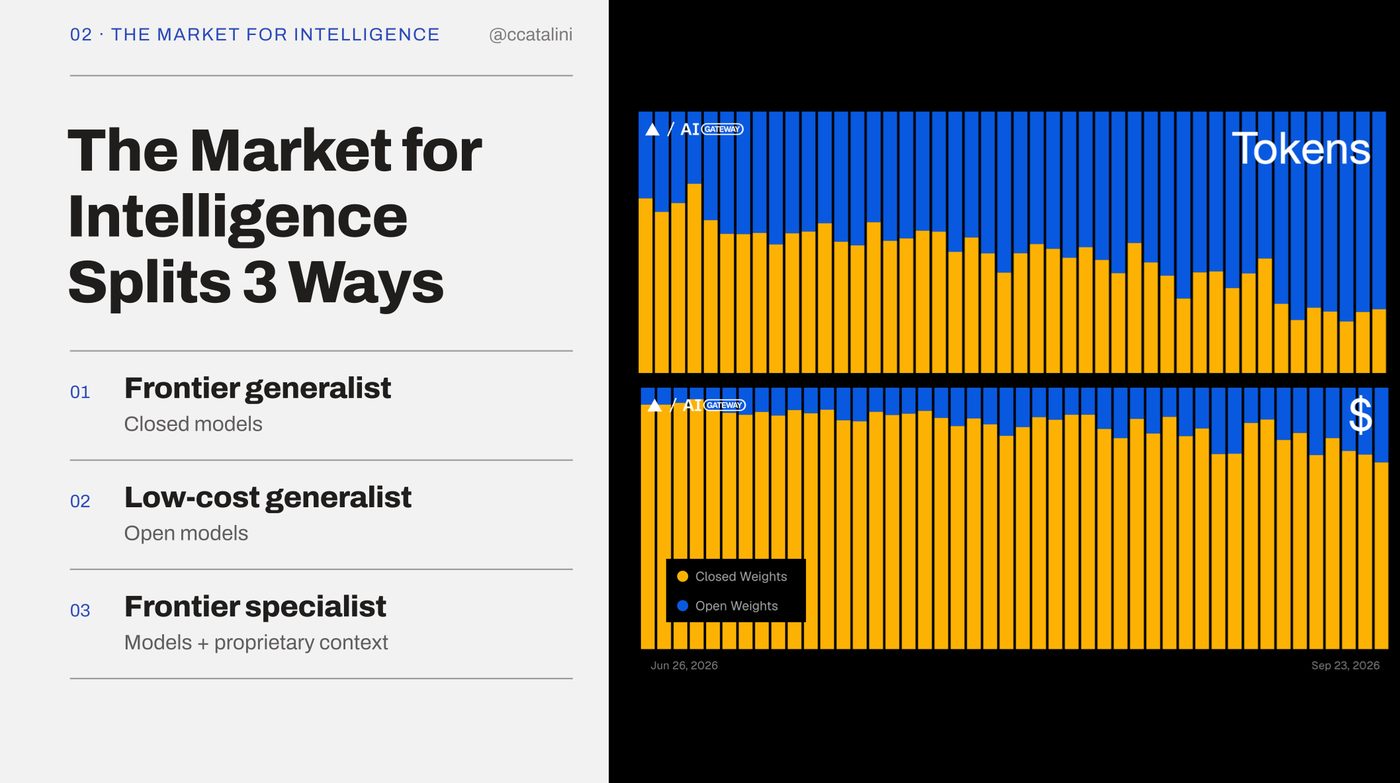
The market for intelligence splits three ways.
- Frontier generalists (closed) take the top of the demand curve.
- Low-cost generalists (open) run most tokens.
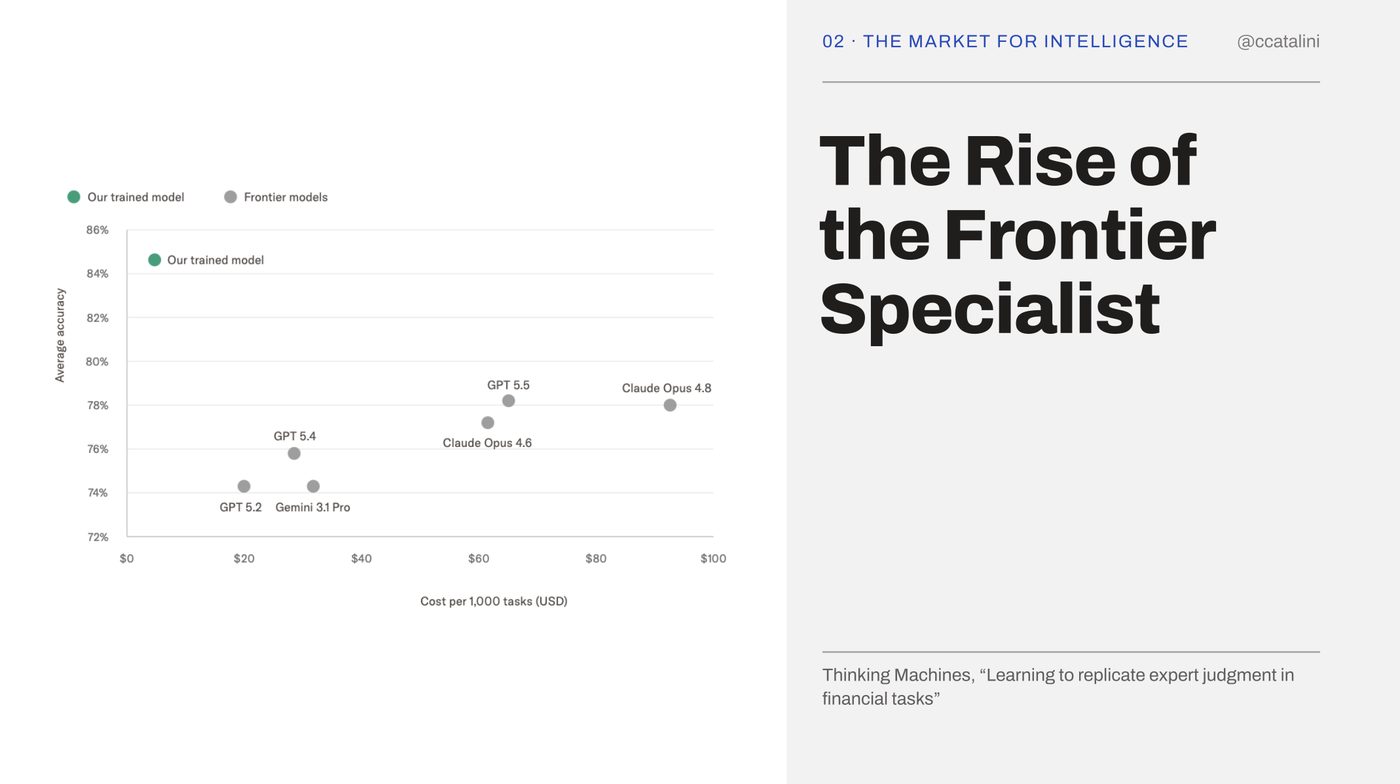
- Enterprises worried about disintermediation scale frontier specialists: open models plus proprietary context.
A frontier specialist starts with open weights, adds proprietary context, expert feedback and evals.
In their domain, frontier specialists will beat closed labs on price & quality. Companies keep control, without funding/training their own replacement.
Expect more of this.
The labs have one more problem: they need to be successful, but not too successful.
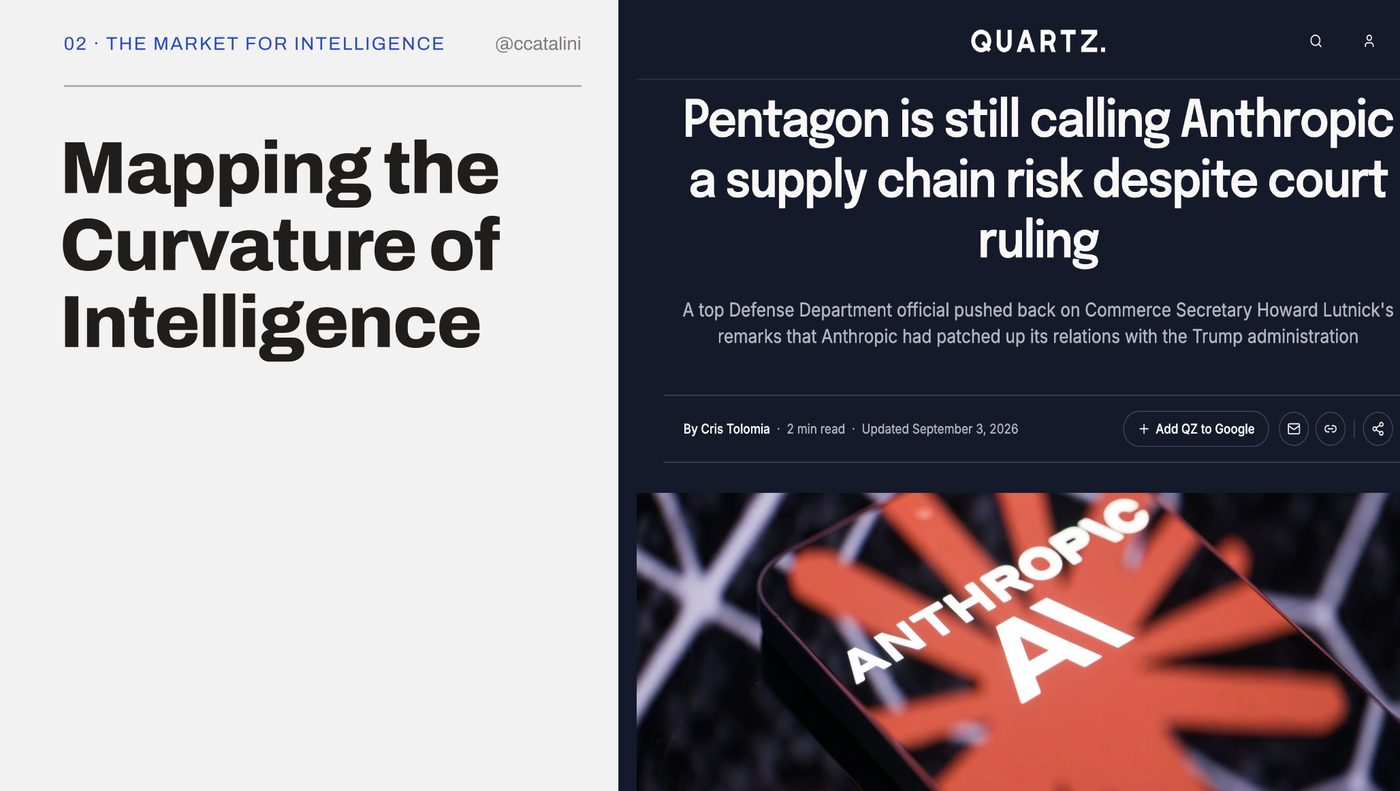
The only company left in the world gets nationalized, or turned into a regulated utility, metered by the token.
So where does value ultimately accrue?
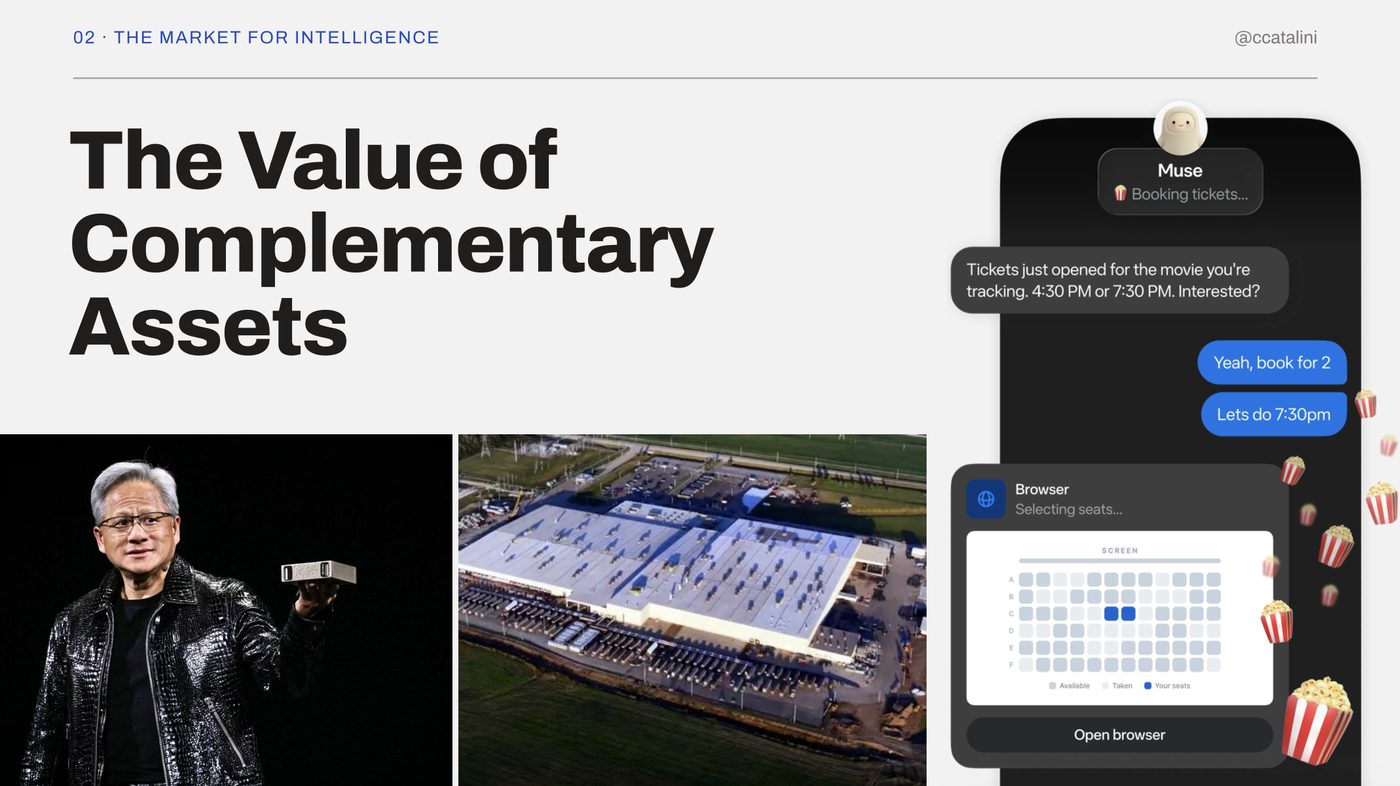
To whoever holds the complementary assets: chips, the ability to turn atoms into datacenters, distribution, and reliable products customers and businesses pay for.
The 2026 equivalents of farmland, factories and Sears.
Regulation could create one more complementary asset: permission to compete. If policy, safety and compliance costs become barriers to entry, the big labs get a real moat.

So how do you survive the moatpocalypse?
Start from one observation: anything that can be measured will be automated.
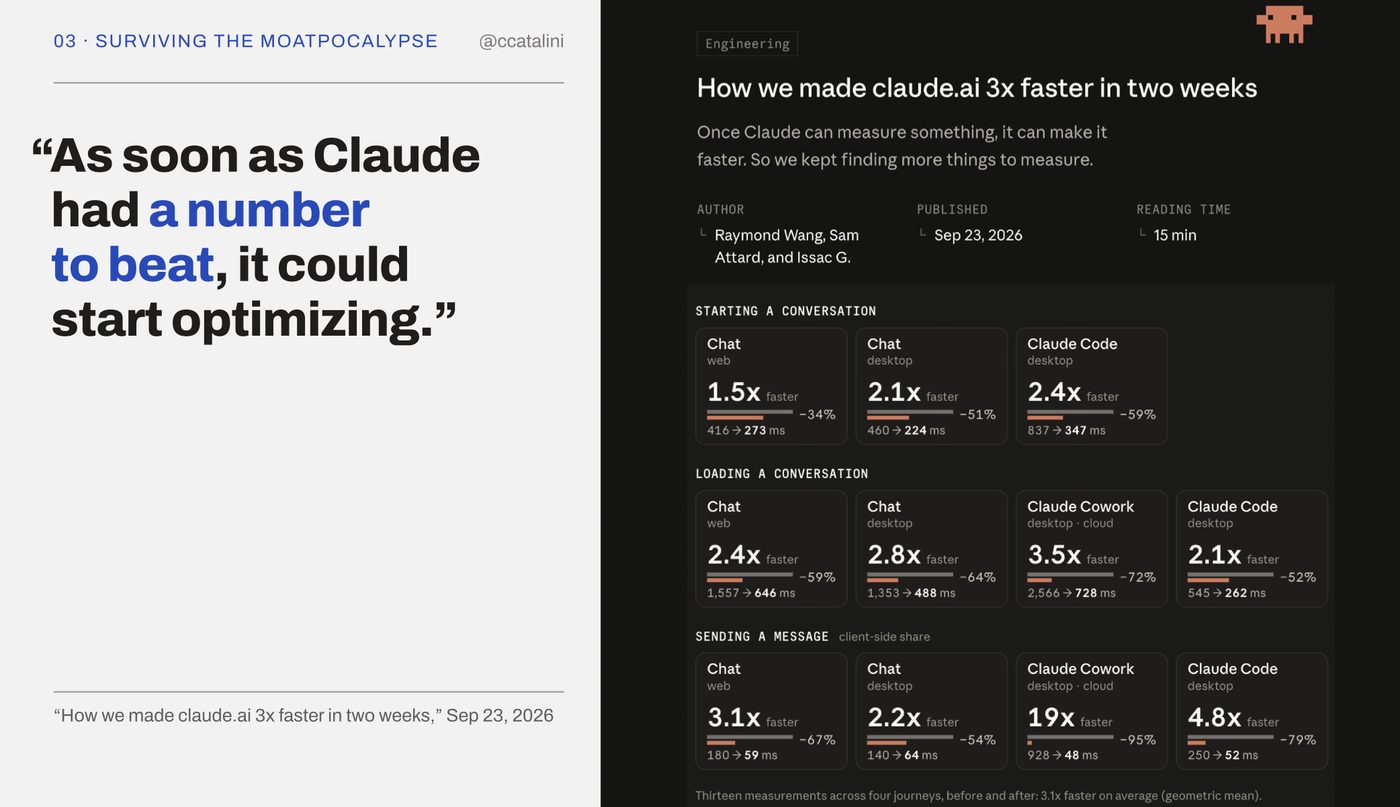
Most of the scaling recipe to date is better measurement, not better models.
Han & Dwarkesh Patel put 12x of pretraining progress down to better data and 3.7x to better models.
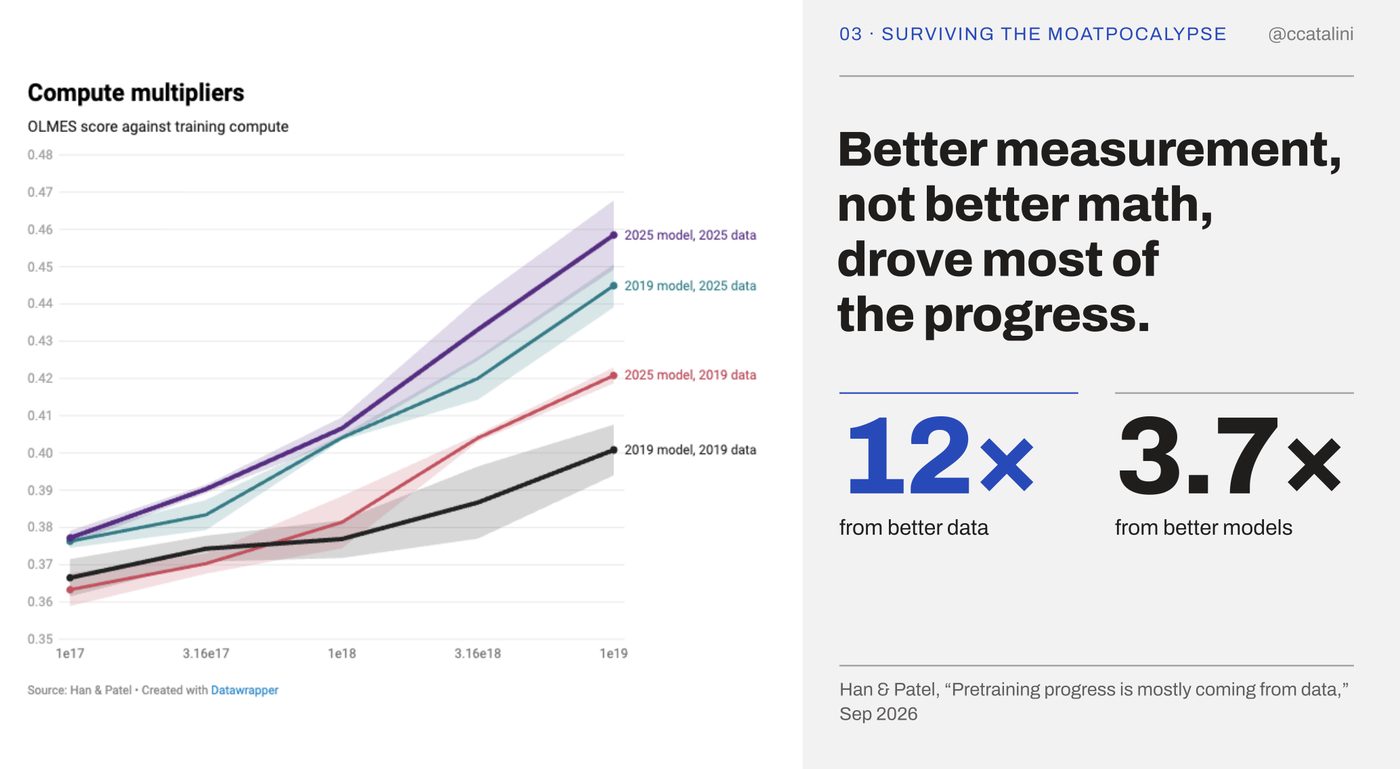
You can’t safely automate what you can’t reliably measure and verify.
Verification means checking that the agent did what you intended. As execution gets cheaper, proving the task was done right becomes the bottleneck to safe scaling.
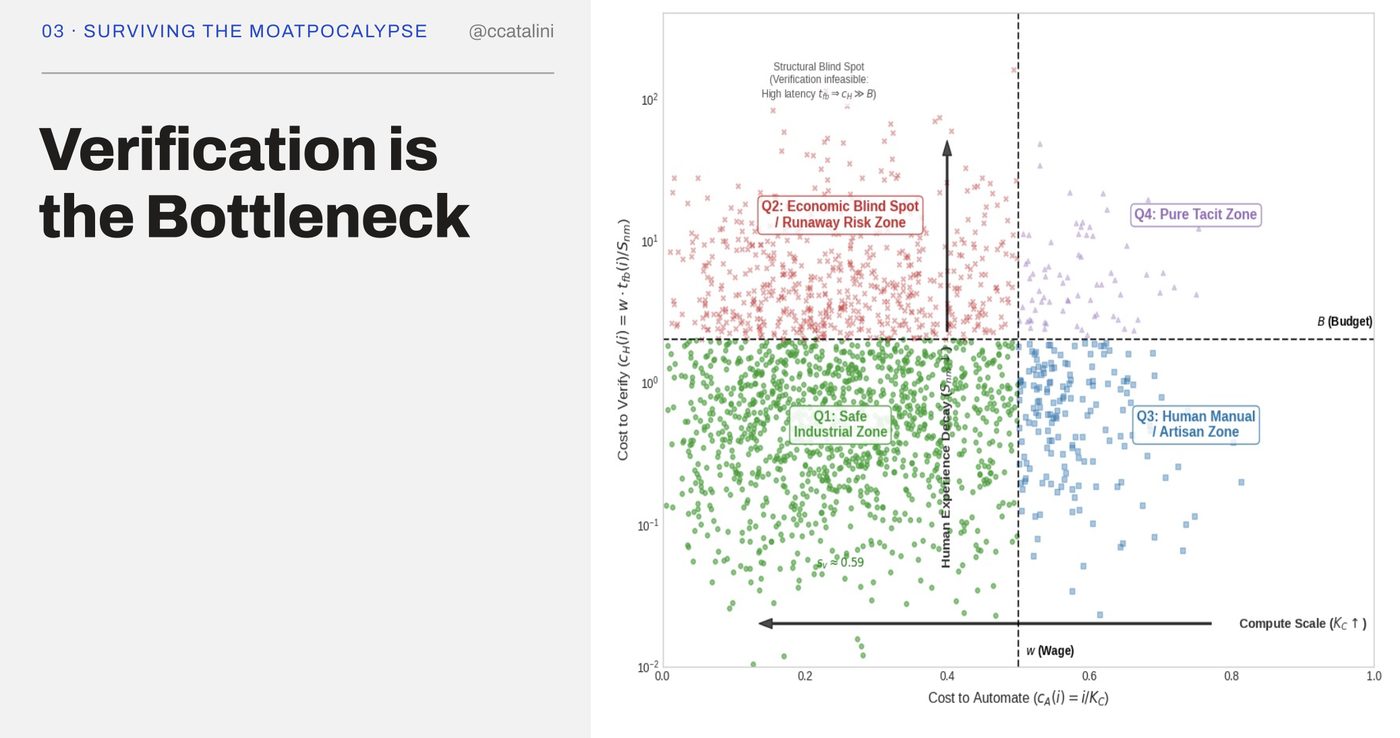
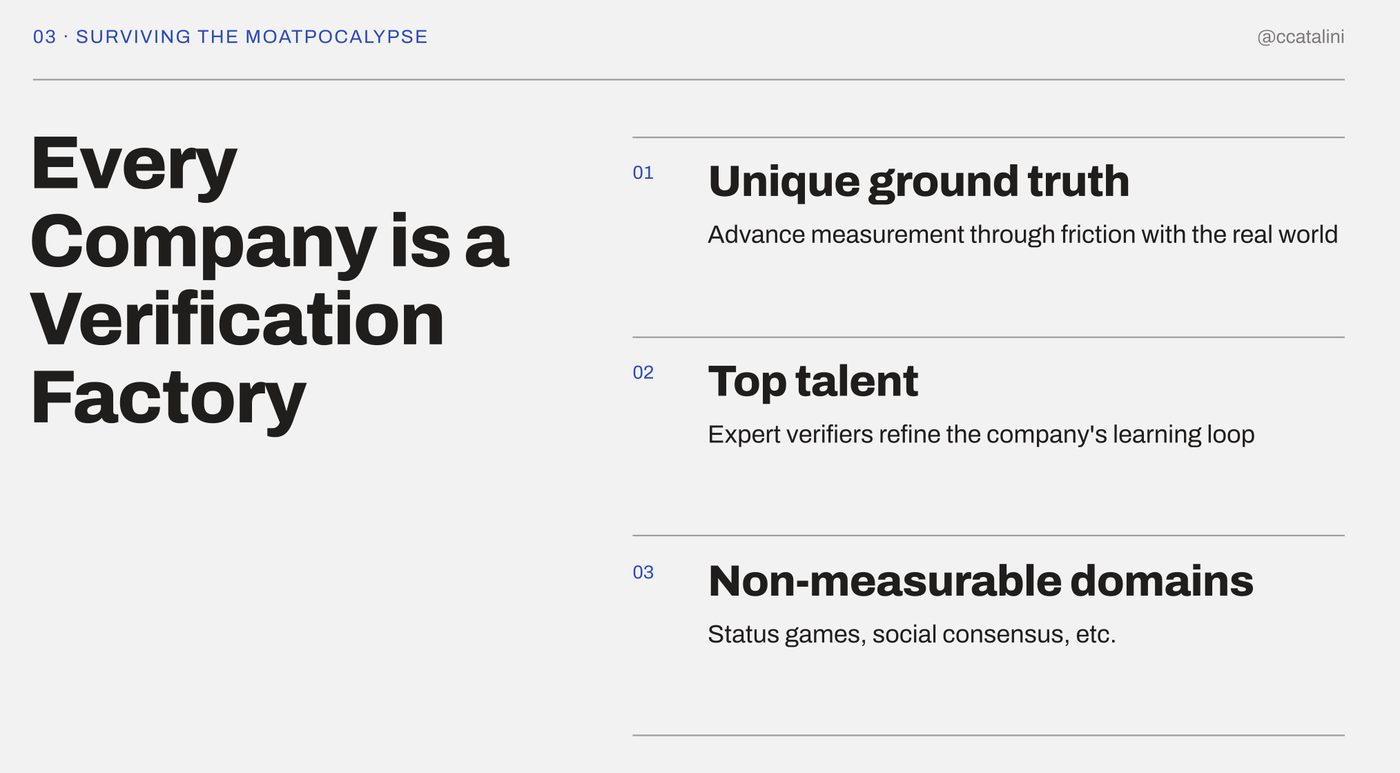
Which is why every company needs to become a verification factory.
Two areas of focus: advance measurement through friction with the real world faster than your competitors, and recruit the best verifiers in your domain.
The only network effects that survive AI are verification-grade ones: the ones that benefit from the loop from new measurement and ground truth, to compute, to higher-quality verification that feeds back into new measurement.
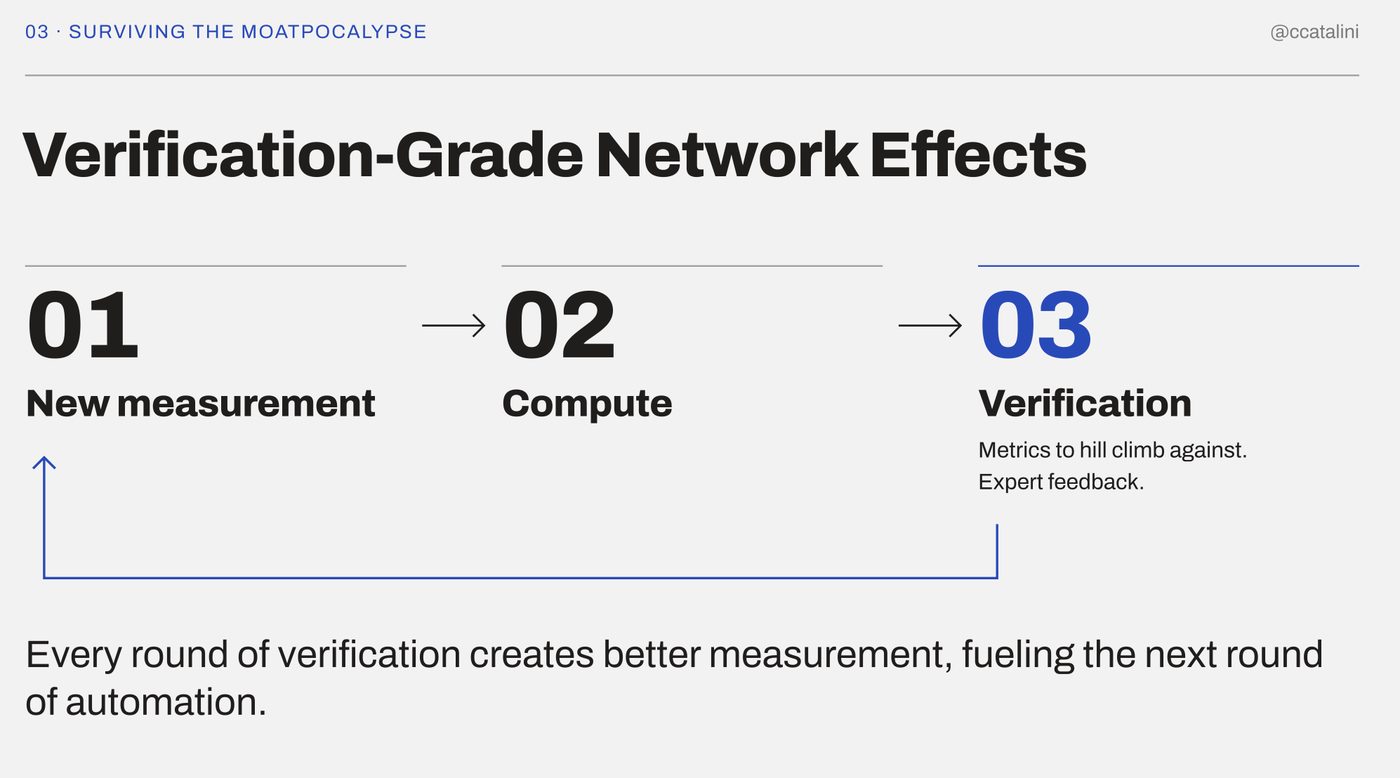
Establishing verification-grade network effects is not enough. You also need to own the underlying loop to begin with.
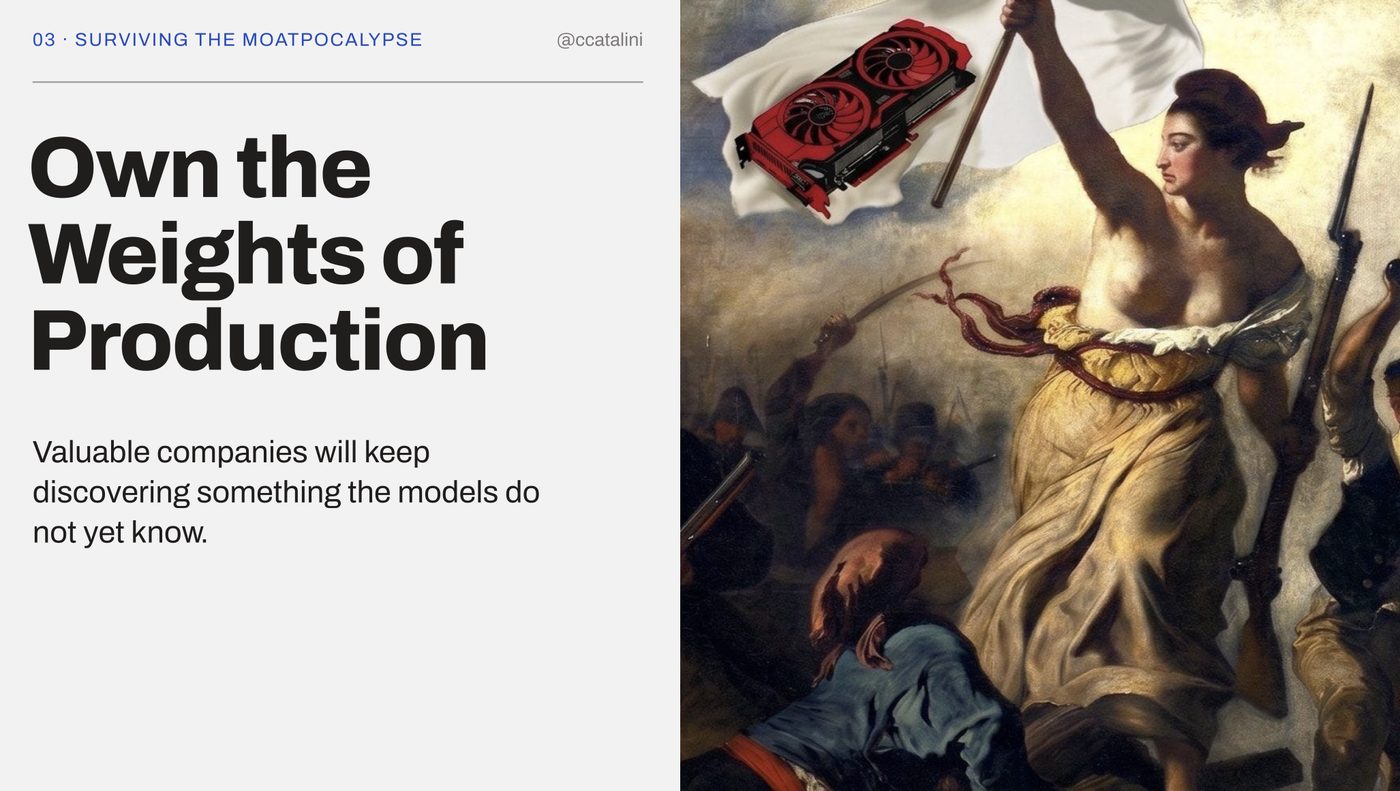
That means owning the weights of production!
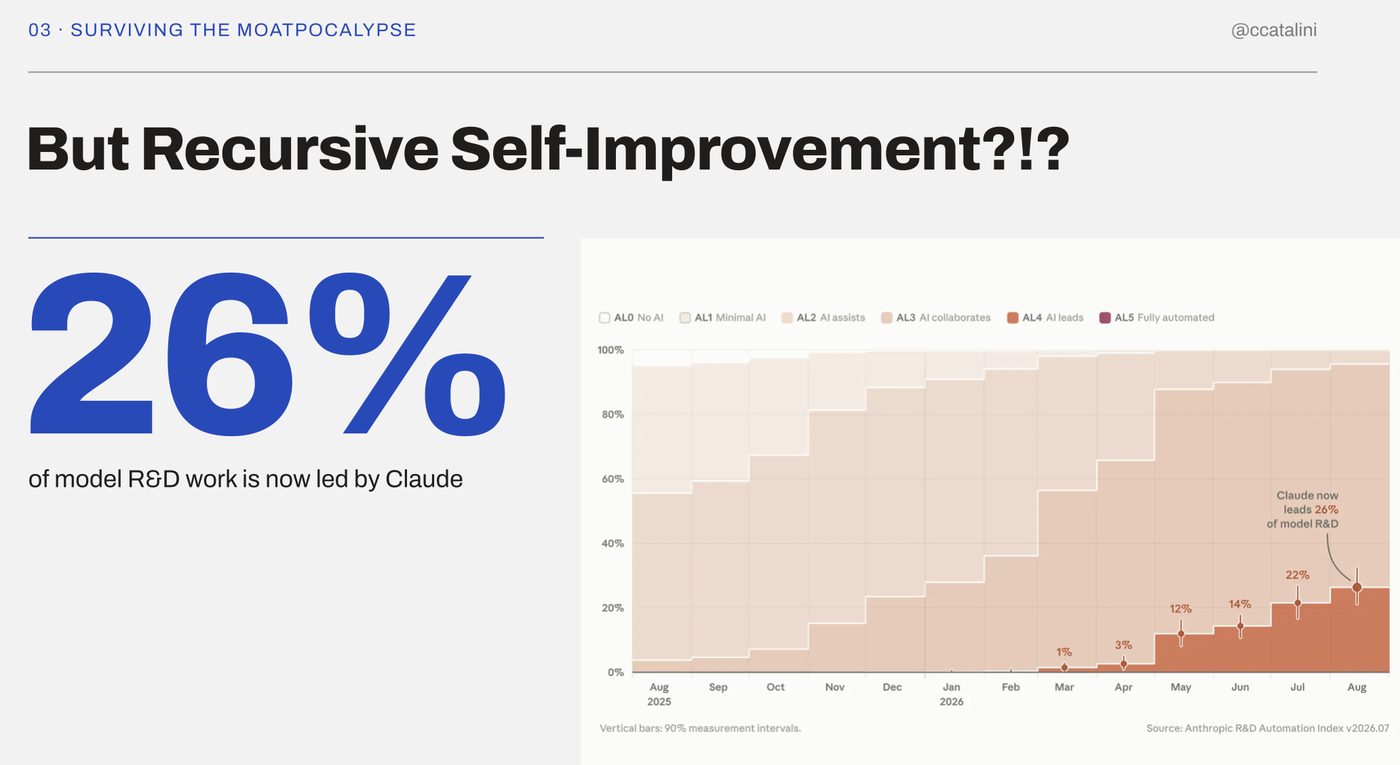
But what about RSI? 26% of model R&D is now led by Claude, so progress is real.
The last mile will stay a bottleneck. And more capable AI makes knowledge on the periphery worth more, not less. Which feeds back to the owners of complementary assets and context.
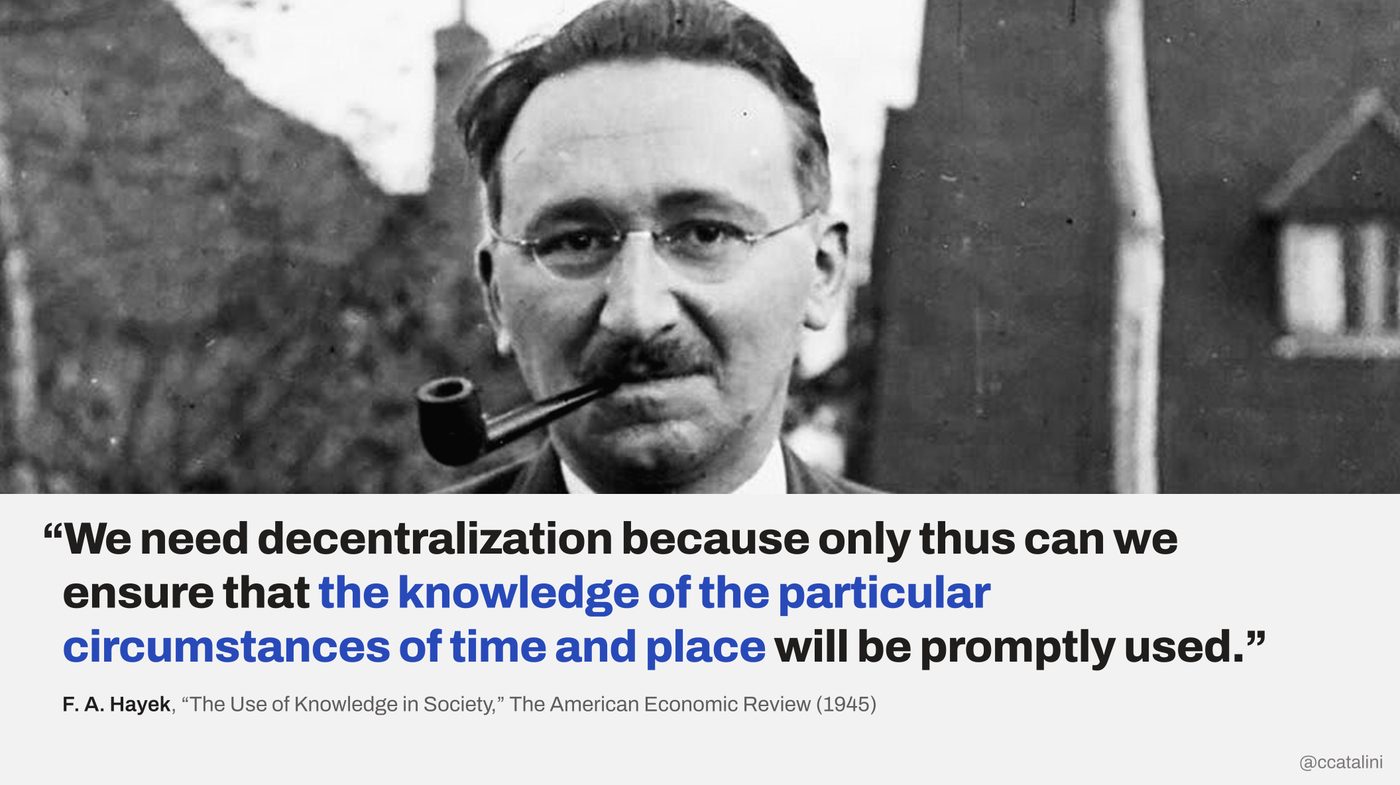
Hayek’s objection to central planning was never a shortage of compute. It was that the knowledge an economy runs on is tacit and tied to time and place.
That holds for AI however capable it gets, which points to a world of many competing intelligences, not one company left.
A version of this article appeared on Substack.