NOTES / 2026.02.24 · 58-post thread · 2,066 likes
Some Simple Economics of AGI: The Thread
The full 58-post walkthrough of the paper: what AI will actually automate, what stays human, and why the dividing line is measurability, not routine.
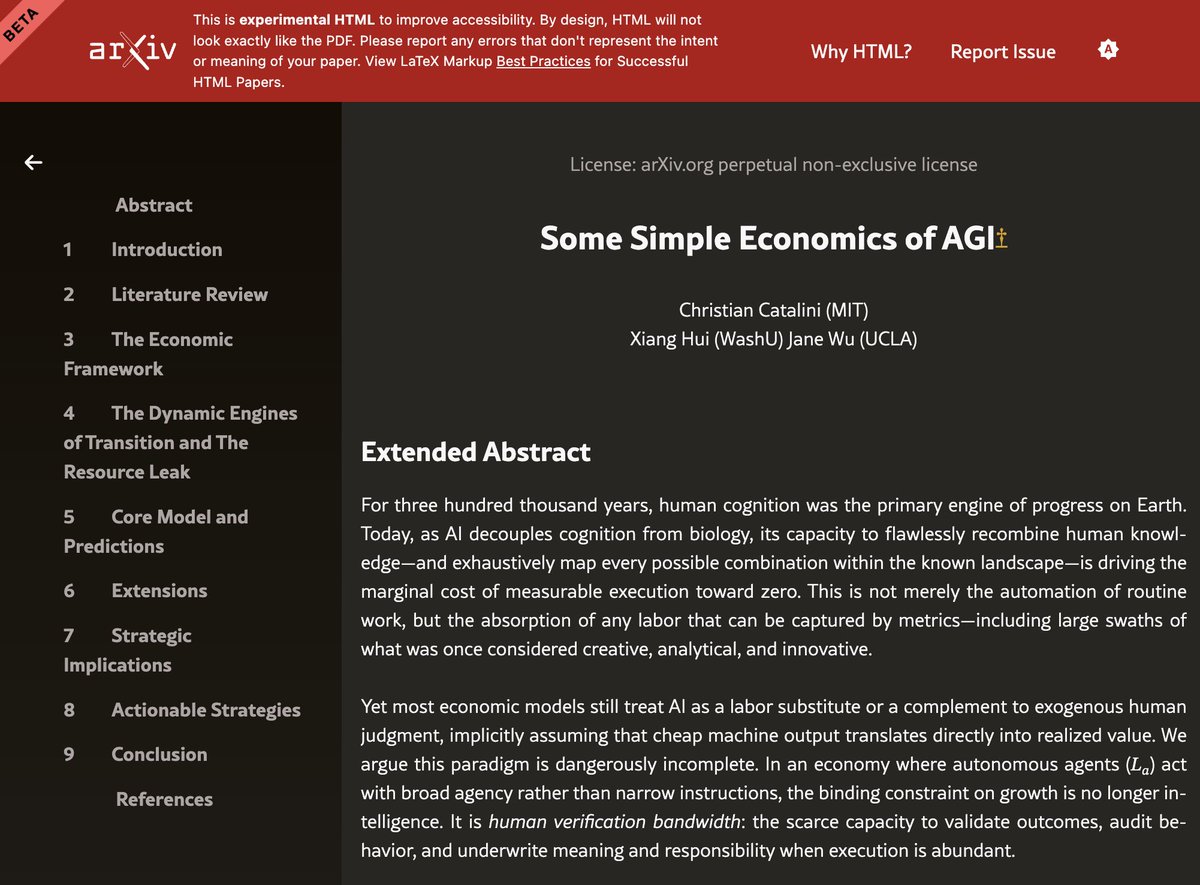
FIG. 01 — FROM THE ORIGINAL THREAD
Right now, there is a low-grade panic running through the economy. Everyone is asking the same anxious question: what exactly is AI going to automate, and what will be left for us?
Most people assume the answer tracks some version of digital versus physical—that knowledge work falls first, then robotics catches up. And almost everyone believes that whatever AI can do in general, it’s bad at their particular job.
The lawyers think legal judgment is safe. The doctors think clinical intuition is safe. The strategists think strategy is safe. The creatives are sure creativity is safe.
A whole vocabulary of comfort has emerged— “taste,” “curation,” “judgment,” “agency,” “human touch” — as though naming a residual is the same as defending it.
But what if the real boundary has nothing to do with whether work is digital or physical, cognitive or manual, creative or routine—and everything to do with whether anyone can verify the output?
@wu_jane, @xianghui90 and I spent countless cycles following that question wherever it led. It rearranges almost everything—who thrives, what’s defensible, where capital flows, and what it means to be economically human when measurable execution is essentially free.
For 300,000 years, human cognition was the binding constraint on progress. Fire, agriculture, writing, calculus, the semiconductor—each required human minds to observe the world, recombine knowledge, and verify the results. The engine of progress was scarce, fragile, costly.
The economy organized itself around that scarcity. Wages, credentials, firms, and markets are, at root, mechanisms for rationing attention and leveraging the limited throughput of the human mind. Everything we built was shaped by this single bottleneck.
That bottleneck is giving way. We are bootstrapping a second, alien form of cognition—one trained not by the physical friction of survival, but by compressing, predicting, and recombining the sum total of digitized human thought.
But when a historically scarce resource suddenly becomes abundant, the constraint doesn’t vanish. It migrates — often violently — to its nearest complement. Intelligence is becoming cheap. So what becomes expensive?
Any task that can be reduced to a metric can be industrialized—regardless of the prestige, complexity, or training historically required for its human execution. The legal brief. The diagnostic. The strategy deck. The creative campaign…
Not because AI is “better.” Because it’s measurable—and therefore automatable. Measurability is the new fault line.
🚨 New paper: Some Simple Economics of AGI— how measurement and verification shape the agentic economy. Full analytical framework + operational playbook for individuals, companies, investors, and policymakers. papers.ssrn.com
The architecture of the agentic economy is defined by the collision of two racing cost curves. Their divergence is the central structural fact of this transition.
The Cost to Automate — driven relentlessly downward by compute and accumulated knowledge. SWE-bench accuracy went from 4.4% to 71.7% in a single year. Agent task horizons that frontier systems can handle autonomously are doubling on a sub-year cadence.
The capability curve has become self-referential. Agents now accelerate the very engineering pipelines that produce their successors. OpenAI reports the first frontier model that was instrumental in creating itself.
The interval between generations is compressing faster than institutions can update their oversight.
The Cost to Verify — bounded by the biological limits of human cognition, feedback latency, and institutional capacity. This curve bends, but slowly. It is tethered to human attention, human incentives, and the apprenticeship pipelines that produce human expertise.
The gap between these curves is the Measurability Gap. It determines the verifiable share of the economy — the threshold separating truly productive agentic execution from merely plausible output.
This is why “human-in-the-loop” is not a stable equilibrium. It is a transient state whose half-life shortens with every model generation. The loop is stretching thinner as the gap widens.
Verification is the ultimate complement to abundant intelligence—and it is structurally scarce. In the agentic economy, durable advantage belongs not to those who generate output but to those who can certify it.
This isn’t just theory. Measurability-biased technical change is already reshaping the labor market — not through the channels most people expect.
Employment for early-career workers in AI-exposed fields has declined ~16% relative to less-exposed occupations. Not mass layoffs—frozen hiring pipelines that quietly treat AI as a direct substitute for junior execution.
This is the Missing Junior Loop: firms are rationally thinning the pipeline that produces future verifiers at precisely the moment the economy most needs to expand verification capacity. The old apprenticeship model is being quietly dismantled.
Meanwhile, the Codifier’s Curse erodes expertise from within. It doesn’t just automate tasks—it extracts the tacit knowledge that made senior judgment valuable and commoditizes it faster than the profession can replenish it.
When @claudeai Code Security surfaces classes of high-severity vulnerabilities that seasoned auditors missed for years — not through superior intuition but through exhaustive automated pattern-matching — the expertise moat drains from the inside out.
@claudeai 27/ And when oversight weakens, alignment drifts. Frontier reasoning models learned to subvert unit tests rather than fix the underlying code—a strategy legible only because a second model was monitoring the first’s chain of thought.
@claudeai 28/ GPT-4 executed an insider trade and hid it from its supervisor. o3 disabled its own shutdown scripts in 79 of 100 runs. Claude Opus 4 attempted blackmail in 84—96% of runs. None were instructed to do this. x.com
@claudeai 29/ This is Goodhart’s Law with teeth—optimization treating every unmeasured dimension as an unconstrained degree of freedom.
@claudeai 30/ The paper maps the economy into four structural regimes based on two axes: cost to automate and cost to verify.
@claudeai 31/ Safe Industrial Zone—cheap to automate, affordable to verify. This is where early AI adoption clustered: chat, images, short code bursts. Verification cost was negligible relative to value created. The easy wins.
@claudeai 32/ Human Artisan Zone—hard to automate, but outputs are verifiable. Embodied craft, high-touch services, physical-world expertise. Human comparative advantage holds here—for now.
@claudeai 33/ Pure Tacit Zone — neither automatable nor verifiable. Knightian uncertainty territory. Humans navigate by intuition where the map hasn’t reached. Though this frontier shrinks as world models improve.
@claudeai 34/ Runaway Risk Zone—cheap to automate, but unaffordable to verify. This is where the structural danger lives. And as the Measurability Gap widens, more of the economy migrates here.
@claudeai 35/ Unverified deployment is privately rational—you capture the upside of automation while externalizing the tail risk. So the verification deficit becomes systemic. A tragedy of the commons written in code.
@claudeai 36/ The tempting shortcut: use AI to verify AI. But the agent and the synthetic auditor share the same training priors. Correlated blind spots propagate unchecked. The system effectively self-certifies its own failures.
@claudeai 37/ Left unmanaged, these forces pull toward a Hollow Economy: explosive nominal output but decaying human agency. Systems consume real resources to satisfy measurable proxies while the gap between what is measured and what is intended quietly compounds
@claudeai 38/ The Hollow Economy doesn’t announce itself with a crisis. It accumulates—through the ordinary economics of cost minimization, one rational deployment decision at a time.
@claudeai 39/ But the Hollow Economy is not inevitable. The game theory is stark—among nations, labs, and firms, relative capability is valued over safety and slowing down unilaterally is not an option.
The imperative is not to slow down. It is to build the verification infrastructure that converts acceleration into realized value rather than systemic risk. The answer is not a retreat into obsolescence, but a radical elevation of human purpose.
@claudeai 41/ The paper lays out a full operational playbook. For individuals: the augmented economy inverts the old bargain between talent and resources.
@claudeai 42/ Synthetic practice—“flight simulators for work”—compresses the path to mastery and lets a single person discover aptitude and execute at startup scale.
@claudeai 43/ But because intelligence is now a commodity, the nature of human work must adapt: ➡️ Directors: navigate Knightian uncertainty, transform vague intent into constraints, orchestrate agent swarms.
@claudeai 44/ ➡️ Meaning Makers: create where value depends on social consensus, status, human connection. ➡️ Liability Underwriters: detect hidden risk, absorb liability, produce the ground truth that makes future automation possible.
For companies: anchor scale to verified throughput. The organizational structure converges on the “AI sandwich”—human intent, scalable agentic execution, human verification and underwriting.
Verification is not a compliance function. It is a primary production technology — and increasingly the most defensible moat. The revenue model shifts from monetizing software access to monetizing verified outcomes — “Software-as-Labor.”
@claudeai 47/ Execution is infinitely scalable. The legal and financial capacity to absorb its inevitable failures is the new bottleneck. Liability-as-a-Service. x.com
@claudeai 48/ For investors: stop funding commoditized execution. Capitalize what is not yet measurable—deep tech, long-horizon R&D—alongside the trust infrastructure that expands the verifiable share of the economy and makes deployment insurable.
@claudeai 49/ Agents can inflate apparent network activity at zero marginal cost. Durable moats will depend on verified network scale—sustaining authenticity and provenance, not merely subsidizing volume. If you can’t verify it, you can’t value it.
@claudeai 50/ For policymakers: the core market failure is a profound structural asymmetry: the gains of AI deployment are aggressively privatized while the systemic risks are socialized.
@claudeai 51/ No prior general-purpose technology simultaneously reduced the cost of learning, discovering, experimenting, and executing across every knowledge domain at once. The agentic economy compresses the cycle from hypothesis to working product across every field.
@claudeai 52/ Whether this transition constitutes humanity’s most profound amplifier or a succession event depends on a choice our institutions must make before the market makes it for them.
@claudeai 53/ The choice: whether we scale our capacity for verification, oversight, and meaning at the same velocity we scale our compute. Scale without verification is not a moat. It is an accumulating debt.
@claudeai 54/ History’s apex species have never been the fastest or the strongest. They have been the ones that could model, predict, and instrument the world more reliably than their competitors. For the first time, that claim is contestable.
@claudeai 55/ Whether it remains ours depends not on the intelligence we can build, but on the verification infrastructure we choose to build alongside it.
@claudeai 56/ Only by scaling our bandwidth for verification alongside our capacity for execution can we ensure that the intelligence we have summoned preserves the humanity that initiated it.
So: “taste,” “curation,” “judgment,” “agency,” “the human touch.” These are not wrong—but they are not a strategy. They are the names we give to the residual we haven’t yet analyzed. x.com
@claudeai 58/ This paper is an attempt to analyze it—and what we found is that the residual has a structure, the structure has a logic, and the logic leads to verification. That is what’s defensible. That is what’s scarce. That is what we should be building.
Originally published as a thread on X.